
Mechanisms of RNA viruses endomembrane hijacking - Marion Clavel
Séminaire assuré par Marion Clavel, du Max Planck Institute of Molecular Plant Physiology (Germany), dans le cadre du cycle 2026 des séminaires Biologie Agrosciences.
Titre complet : Mechanisms of RNA viruses endomembrane hijacking, plant perception and mitigation strategies
- Date : 18 septembre 2026
- Horaire : 11h00
- Lieu : Salle de séminaire de l'IBVM, UMR BFP, campus INRAE de la Grande-Ferrade (Villenave d'Ornon)
Invitation Amélie Bernard, UMR LBM
Resume
RNA viruses co-opt host intracellular structures to create specialized replication sites and advance infection. To achieve this, single stranded RNA viruses infecting eukaryotes, including plants, encode specialized viral effectors, that are believed to license entry of host factor into viral replication complexes (VRCs). Yet the molecular mechanism that govern this activity is poorly understood.
Our group employs cell biology, proteomics and structure-to-function approaches to tackle these questions. Sampling throughout the diversity of the viral family Tombusviridae, we show that viral effectors are bimodal proteins with a novel, structurally conserved C-terminal fold which forms functional oligomers. The response of the host to this membrane disruption is also poorly understood. we show that A. thaliana activates selective autophagy to respond to viruses targeting mitochondria, chloroplasts, and the endoplasmic reticulum. Rather than degrading viral components, autophagy selectively removes the immune regulator Enhanced Disease Susceptibility 1 (EDS1) to prevent cell death. This targeted mechanism is mediated by oligomeric metabolic enzymes that moonlight as selective autophagy receptors, linking organelle stress to immune homeostasis. Our findings establish selective autophagy as an essential immune rheostat, fine-tuning defense responses and safeguarding cellular integrity to promote host survival during viral infections.
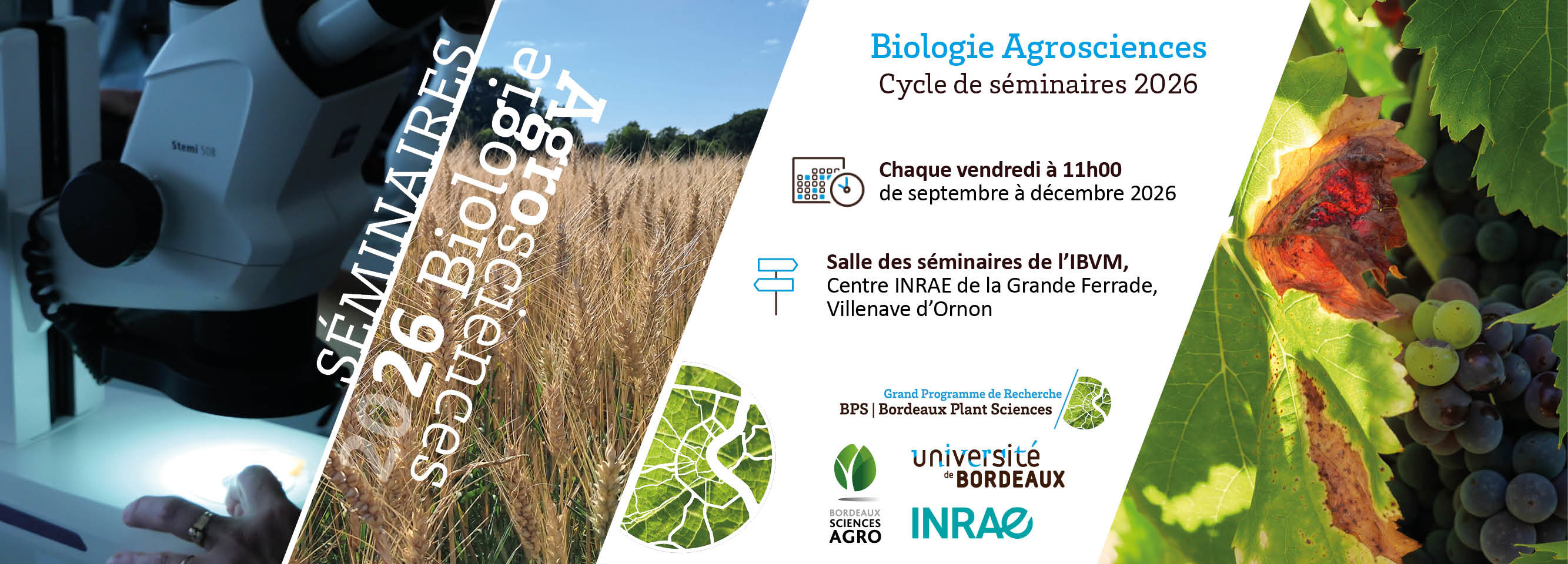
Le cycle de séminaires biologie agrosciences est le fruit de la collaboration entre le Master Biologie Agrosciences Bordeaux (B2AS) et le GPR Bordeaux Plant Sciences pour proposer, chaque vendredi de septembre à décembre 2026, un séminaire scientifique de haut vol avec des chercheuses et chercheurs invités par les unités impliquées dans GPR.
Ces séminaires sont ouverts à l'ensemble des membres du GPR Bordeaux Plant Sciences, et plus largement à l'ensemble de la communauté scientifique bordelaise (chercheurs, techniciens ou étudiants).